Trading

Minggu, 10 Juli 2016

Protection and secuirity operating system

               Protection and Security Operation System

Protection mechanisms control access to a system by limiting the types
of file access permitted to users. In addition, protection must ensure
that only processes that have gained proper authorization from the
operating system can operate on memory segments, the CPU, and other
resources.
Protection is provided by a mechanism that controls the access of
programs, processes, or users to the resources defined by a computer
system. This mechanism must provide a means for specifying the controls
to be imposed, together with a means of enforcing them.
Security ensures the authentication of system users to protect the
integrity of the information stored in the system (both data and code),
as well as the physical resources of the computer system. The security
system prevents unauthorized access, malicious destruction or alteration
of data, and accidental introduction of inconsistency.Protection
The processes in an operating system must be protected from one another’s
activities. To provide such protection,we can use various mechanisms to ensure
that only processes that have gained proper authorization from the operating
system can operate on the files, memory segments, CPU, and other resources
of a system.
Protection refers to a mechanism for controlling the access of programs,
processes, or users to the resources defined by a computer system. This
mechanism must provide a means for specifying the controls to be imposed,
together with a means of enforcement.We distinguish between protection and
security, which is a measure of confidence that the integrity of a system and
its data will be preserved. In this chapter, we focus on protection. Security
assurance is a much broader topic, and we address it in Chapter 15.

CHAPTER OBJECTIVES
• To discuss the goals and principles of protection in a modern computer
system.
• To explain how protection domains, combined with an access matrix, are
used to specify the resources a process may access.
• To examine capability- and language-based protection systems.

14.1 Goals of Protection
As computer systems have become more sophisticated and pervasive in their
applications, the need to protect their integrity has also grown. Protection was
originally conceived as an adjunct to multiprogramming operating systems,
so that untrustworthy users might safely share a common logical name space,
such as a directory of files, or share a common physical name space, such as
memory. Modern protection concepts have evolved to increase the reliability
of any complex system that makes use of shared resources.
We need to provide protection for several reasons. The most obvious is the
need to prevent the mischievous, intentional violation of an access restriction
by a user. Of more general importance, however, is the need to ensure that
each program component active in a system uses system resources only in
ways consistent with stated policies. This requirement is an absolute one for a
reliable system.
Protection can improve reliability by detecting latent errors at the interfaces
between component subsystems. Early detection of interface errors can often
prevent contamination of a healthy subsystem by a malfunctioning subsystem.
Also, an unprotected resource cannot defend against use (or misuse) by an
unauthorized or incompetent user. A protection-oriented system provides
means to distinguish between authorized and unauthorized usage.
The role of protection in a computer system is to provide a mechanism for
the enforcement of the policies governing resource use. These policies can be
established in a variety of ways. Some are fixed in the design of the system,
while others are formulated by the management of a system. Still others are
defined by the individual users to protect their own files and programs. A
protection system must have the flexibility to enforce a variety of policies.
Policies for resource use may vary by application, and they may change
over time. For these reasons, protection is no longer the concern solely of
the designer of an operating system. The application programmer needs to
use protection mechanisms as well, to guard resources created and supported
by an application subsystem against misuse. In this chapter, we describe the
protection mechanisms the operating system should provide, but application
designers can use them as well in designing their own protection software.
Note that mechanisms are distinct from policies. Mechanisms determine
how something will be done; policies decide what will be done. The separation
of policy and mechanism is important for flexibility. Policies are likely to
change from place to place or time to time. In the worst case, every change
in policy would require a change in the underlying mechanism. Using general
mechanisms enables us to avoid such a situation.
 
14.2 Principles of Protection
Frequently, a guiding principle can be used throughout a project, such as
the design of an operating system. Following this principle simplifies design
decisions and keeps the system consistent and easy to understand. A key,
time-tested guiding principle for protection is the principle of least privilege. It
dictates that programs, users, and even systems be given just enough privileges
to perform their tasks.
Consider the analogy of a security guard with a passkey. If this key allows
the guard into just the public areas that she guards, then misuse of the key
will result in minimal damage. If, however, the passkey allows access to all
areas, then damage from its being lost, stolen, misused, copied, or otherwise
compromised will be much greater.
An operating system following the principle of least privilege implements
its features, programs, system calls, and data structures so that failure or
compromise of a component does the minimum damage and allows the
minimum damage to be done. The overflow of a buffer in a system daemon
might cause the daemon process to fail, for example, but should not allow the
execution of code from the daemon process’s stack that would enable a remoteuser to gain maximum privileges and access to the entire system (as happens
too often today).
Such an operating system also provides system calls and services that
allow applications to be written with fine-grained access controls. It provides
mechanisms to enable privileges when they are needed and to disable them
when they are not needed. Also beneficial is the creation of audit trails for
all privileged function access. The audit trail allows the programmer, system
administrator, or law-enforcement officer to trace all protection and security
activities on the system.
Managing users with the principle of least privilege entails creating a
separate account for each user, with just the privileges that the user needs. An
operator who needs to mount tapes and back up files on the system has access
to just those commands and files needed to accomplish the job. Some systems
implement role-based access control (RBAC) to provide this functionality.
Computers implemented in a computing facility under the principle of least
privilege can be limited to running specific services, accessing specific remote
hosts via specific services, and doing so during specific times. Typically, these
restrictions are implemented through enabling or disabling each service and
through using access control lists, as described in Sections Section 11.6.2 and
Section 14.6.
The principle of least privilege can help produce a more secure computing
environment. Unfortunately, it frequently does not. For example, Windows
2000 has a complex protection scheme at its core and yet has many security
holes. By comparison, Solaris is considered relatively secure, even though it
is a variant of UNIX, which historically was designed with little protection
in mind. One reason for the difference may be that Windows 2000 has more
lines of code and more services than Solaris and thus has more to secure and
protect. Another reason could be that the protection scheme inWindows 2000
is incomplete or protects the wrong aspects of the operating system, leaving
other areas vulnerable.
 
14.3 Domain of Protection
Acomputer system is a collection of processes and objects. By objects, we mean
both hardware objects (such as the CPU, memory segments, printers, disks, and
tape drives) and software objects (such as files, programs, and semaphores).
Each object has a unique name that differentiates it from all other objects in the
system, and each can be accessed only through well-defined and meaningful
operations. Objects are essentially abstract data types.
The operations that are possible may depend on the object. For example,
on a CPU, we can only execute. Memory segments can be read and written,
whereas a CD-ROM or DVD-ROM can only be read. Tape drives can be read,
written, and rewound. Data files can be created, opened, read, written, closed,
and deleted; program files can be read, written, executed, and deleted.
A process should be allowed to access only those resources for which it
has authorization. Furthermore, at any time, a process should be able to access
only those resources that it currently requires to complete its task. This second
requirement, commonly referred to as the need-to-know principle, is useful
in limiting the amount of damage a faulty process can cause in the system.For example, when process p invokes procedure A(), the procedure should be
allowed to access only its own variables and the formal parameters passed to it;
it should not be able to access all the variables of process p. Similarly, consider
the case in which process p invokes a compiler to compile a particular file. The
compiler should not be able to access files arbitrarily but should have access
only to a well-defined subset of files (such as the source file, listing file, and
so on) related to the file to be compiled. Conversely, the compiler may have
private files used for accounting or optimization purposes that process p should
not be able to access. The need-to-know principle is similar to the principle of
least privilege discussed in Section 14.2 in that the goals of protection are to
minimize the risks of possible security violations.
 
14.3.1 Domain Structure
To facilitate the scheme just described, a process operates within a protection
domain, which specifies the resources that the process may access. Each
domain defines a set of objects and the types of operations that may be invoked
on each object. The ability to execute an operation on an object is an access
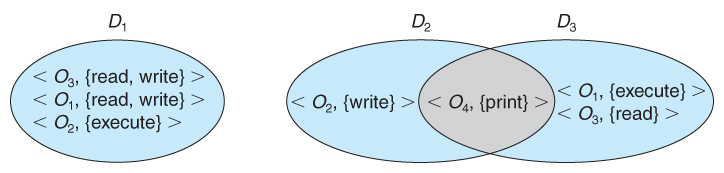
right. A domain is a collection of access rights, each of which is an ordered
pair <object-name, rights-set>. For example, if domain D has the access
right <file F, {read,write}>, then a process executing in domain D can both
read and write file F. It cannot, however, perform any other operation on that
object.
Domains may share access rights. For example, in Figure 14.1, we have
three domains: D1, D2, and D3. The access right <O4, {print}> is shared by D2
and D3, implying that a process executing in either of these two domains can
print object O4. Note that a process must be executing in domain D1 to read
and write object O1, while only processes in domain D3 may execute object O1.
The association between a process and a domain may be either static, if
the set of resources available to the process is fixed throughout the process’s
lifetime, or dynamic. As might be expected, establishing dynamic protection
domains is more complicated than establishing static protection domains.
If the association between processes and domains is fixed, and we want to
adhere to the need-to-know principle, then a mechanism must be available to
change the content of a domain. The reason stems from the fact that a process
may execute in two different phases and may, for example, need read access
in one phase and write access in another. If a domain is static, we must define
the domain to include both read and write access. However, this arrangement
provides more rights than are needed in each of the two phases, since we have
read access in the phase where we need only write access, and vice versa.
Thus, t
he need-to-know principle is violated. We must allow the contents of
a domain to be modified so that the domain always reflects the minimum
necessary access rights.
If the association is dynamic, a mechanism is available to allow domain
switching, enabling the process to switch from one domain to another.We may
also want to allow the content of a domain to be changed. If we cannot change
the content of a domain, we can provide the same effect by creating a new
domain with the changed content and switching to that new domain when we
want to change the domain content.
A domain can be realized in a variety of ways:
   • Each user may be a domain. In this case, the set of objects that can be
accessed depends on the identity of the user. Domain switching occurs
when the user is changed—generally when one user logs out and another
user logs in.
    • Each process may be a domain. In this case, the set of objects that can be
accessed depends on the identity of the process. Domain switching occurs
when one process sends a message to another process and then waits for
a response.
   • Each procedure may be a domain. In this case, the set of objects that can be
accessed corresponds to the local variables defined within the procedure.
Domain switching occurs when a procedure call is made.
We discuss domain switching in greater detail in Section 14.4.
Consider the standard dual-mode (monitor–user mode) model of
operating-system execution. When a process executes in monitor mode, it
can execute privileged instructions and thus gain complete control of the
computer system. In contrast, when a process executes in user mode, it can
invoke only nonprivileged instructions. Consequently, it can execute only
within its predefined memory space. These two modes protect the operating
system (executing in monitor domain) from the user processes (executing
in user domain). In a multiprogrammed operating system, two protection
domains are insufficient, since users also want to be protected from one
another. Therefore, a more elaborate scheme is needed. We illustrate such a
scheme by examining two influential operating systems—UNIX and MULTICS
—to see how they implement these concepts.
 
14.3.2 An Example: UNIX
In the UNIX operating system, a domain is associated with the user. Switching
the domain corresponds to changing the user identification temporarily.
This change is accomplished through the file system as follows. An owner
identification and a domain bit (known as the setuid bit) are associated with
each file. When the setuid bit is on, and a user executes that file, the userID is
set to that of the owner of the file. When the bit is off, however, the userID
does not change. For example, when a user A (that is, a user with userID =
A) starts executing a file owned by B, whose associated domain bit is off, the
userID of the process is set to A. When the setuid bit is on, the userID is set tothat of the owner of the file: B. When the process exits, this temporary userID
change ends.
Other methods are used to change domains in operating systems in which
userIDs are used for domain definition, because almost all systems need
to provide such a mechanism. This mechanism is used when an otherwise
privileged facility needs to be made available to the general user population.
For instance, it might be desirable to allow users to access a network without
letting them write their own networking programs. In such a case, on a UNIX
system, the setuid bit on a networking program would be set, causing the
userID to change when the program was run. The userID would change to
that of a user with network access privilege (such as root, the most powerful
userID). One problem with this method is that if a user manages to create a file
with userID root and with its setuid bit on, that user can become root and
do anything and everything on the system. The setuid mechanism is discussed
further in Appendix A.
An alternative to this method used in some other operating systems is
to place privileged programs in a special directory. The operating system is
designed to change the userID of any program run from this directory, either
to the equivalent of root or to the userID of the owner of the directory. This
eliminates one security problem, which occurs when intruders create programs
to manipulate the setuid feature and hide the programs in the system for later
use (using obscure file or directory names). This method is less flexible than
that used in UNIX, however.
Even more restrictive, and thus more protective, are systems that simply
do not allow a change of userID. In these instances, special techniques must
be used to allow users access to privileged facilities. For instance, a daemon
process may be started at boot time and run as a special userID. Users then
run a separate program, which sends requests to this process whenever they
need to use the facility. This method is used by the TOPS-20 operating system.
In any of these systems, great care must be taken in writing privileged
programs. Any oversight can result in a total lack of protection on the system.
Generally, these programs are the first to be attacked by people trying to
break into a system. Unfortunately, the attackers are frequently successful.
For example, security has been breached on many UNIX systems because of the
setuid feature.We discuss security in Chapter 15.
 
14.3.3 An Example: MULTICS
In the MULTICS system, the protection domains are organized hierarchically
into a ring structure. Each ring corresponds to a single domain (Figure 14.2).
The rings are numbered from 0 to 7. Let Di and Dj be any two domain rings.
If j < i, then Di is a subset of Dj . That is, a process executing in domain Dj
has more privileges than does a process executing in domain Di. A process
executing in domain D0 has the most privileges. If only two rings exist, this
scheme is equivalent to the monitor–user mode of execution, where monitor
mode corresponds to D0 and user mode corresponds to D1.
MULTICS has a segmented address space; each segment is a file, and each
segment is associated with one of the rings. A segment description includes an
entry that identifies the ring number. In addition, it includes three access bits


to control reading, writing, and execution. The association between segments
and rings is a policy decision with which we are not concerned here.
A current-ring-number counter is associated with each process, identifying
the ring in which the process is executing currently. When a process is
executing in ring i, it cannot access a segment associated with ring j (j < i). It
can access a segment associated with ring k (k ≥ i). The type of access, however,
is restricted according to the access bits associated with that segment.
Domain switching in MULTICS occurs when a process crosses fromone ring
to another by calling a procedure in a different ring. Obviously, this switch must
be done in a controlled manner; otherwise, a process could start executing in
ring 0, and no protection would be provided. To allow controlled domain
switching, we modify the ring field of the segment descriptor to include the
following:
    • Access bracket. A pair of integers, b1 and b2, such that b1 ≤ b2.
    • Limit. An integer b3 such that b3 > b2.
    • List of gates. Identifies the entry points (or gates) at which the segments
may be called.
If a process executing in ring i calls a procedure (or segment) with access bracket
(b1,b2), then the call is allowed if b1 ≤ i ≤ b2, and the current ring number of
the process remains i. Otherwise, a trap to the operating system occurs, and
the situation is handled as follows:
• If i < b1, then the call is allowed to occur, because we have a transfer to a
ring (or domain)with fewer privileges. However, if parameters are passed
that refer to segments in a lower ring (that is, segments not accessible to
the called procedure), then these segments must be copied into an area
that can be accessed by the called procedure.
• If i > b2, then the call is allowed to occur only if b3 is greater than or equal
to i and the call has been directed to one of the designated entry points inthe list of gates. This scheme allows processes with limited access rights to
call procedures in lower rings that have more access rights, but only in a
carefully controlled manner.
The main disadvantage of the ring (or hierarchical) structure is that it does
not allow us to enforce the need-to-know principle. In particular, if an object
must be accessible in domain Dj but not accessible in domain Di , thenwemust
have j < i. But this requirement means that every segment accessible in Di is
also accessible in Dj .
The MULTICS protection system is generally more complex and less efficient
than are those used in current operating systems. If protection interferes with
the ease of use of the system or significantly decreases system performance,
then its use must be weighed carefully against the purpose of the system. For
instance, we would want to have a complex protection system on a computer
used by a university to process students’ grades and also used by students for
classwork.Asimilar protection system would not be suited to a computer being
used for number crunching, in which performance is of utmost importance.We
would prefer to separate the mechanism from the protection policy, allowing
the same system to have complex or simple protection depending on the needs
of its users. To separate mechanism from policy, we require a more general
model of protection.

14.4 Access Matrix
Our general model of protection can be viewed abstractly as a matrix, called
an access matrix. The rows of the access matrix represent domains, and the
columns represent objects. Each entry in the matrix consists of a set of access
rights. Because the column defines objects explicitly, we can omit the object
name from the access right. The entry access(i,j) defines the set of operations
that a process executing in domain Di can invoke on object Oj .
To illustrate these concepts, we consider the access matrix shown in Figure
14.3. There are four domains and four objects—three files (F1, F2, F3) and one
laser printer. A process executing in domain D1 can read files F1 and F3. A
process executing in domain D4 has the same privileges as one executing in


domain D1; but in addition, it can also write onto files F1 and F3. The laser
printer can be accessed only by a process executing in domain D2.
The access-matrix scheme provides us with the mechanism for specifying
a variety of policies. The mechanism consists of implementing the access
matrix and ensuring that the semantic properties we have outlined hold.
More specifically, we must ensure that a process executing in domain Di can
access only those objects specified in row i, and then only as allowed by the
access-matrix entries.
The access matrix can implement policy decisions concerning protection.
The policy decisions involve which rights should be included in the (i, j)th
entry. We must also decide the domain in which each process executes. This
last policy is usually decided by the operating system.
The users normally decide the contents of the access-matrix entries. When
a user creates a new object Oj, the column Oj is added to the access matrix
with the appropriate initialization entries, as dictated by the creator. The user
may decide to enter some rights in some entries in column j and other rights
in other entries, as needed.
The access matrix provides an appropriate mechanism for defining and
implementing strict control for both static and dynamic association between
processes and domains. When we switch a process fromone domain to another,
we are executing an operation (switch) on an object (the domain). We can
control domain switching by including domains among the objects of the
access matrix. Similarly, when we change the content of the access matrix,
we are performing an operation on an object: the access matrix. Again, we
can control these changes by including the access matrix itself as an object.
Actually, since each entry in the access matrix can be modified individually,
we must consider each entry in the access matrix as an object to be protected.
Now, we need to consider only the operations possible on these new objects
(domains and the access matrix) and decide how we want processes to be able
to execute these operations.
Processes should be able to switch from one domain to another. Switching
from domain Di to domain Dj is allowed if and only if the access right switch
∈ access(i, j). Thus, in Figure 14.4, a process executing in domain D2 can switchone in domain D1 can switch to D2.
Allowing controlled change in the contents of the access-matrix entries
requires three additional operations: copy, owner, and control. We examine
these operations next.
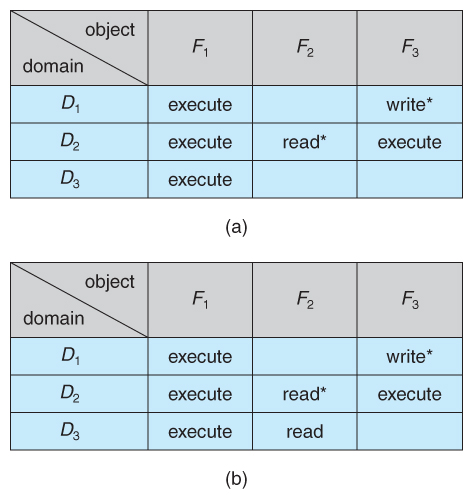
The ability to copy an access right from one domain (or row) of the access
matrix to another is denoted by an asterisk (*) appended to the access right.
The copy right allows the access right to be copied only within the column
(that is, for the object) for which the right is defined. For example, in Figure
14.5(a), a process executing in domain D2 can copy the read operation into any
entry associated with file F2. Hence, the access matrix of Figure 14.5(a) can be
modified to the access matrix shown in Figure 14.5(b).
This scheme has two additional variants:
1. A right is copied from access(i, j) to access(k, j); it is then removed from
access(i, j). This action is a of a right, rather than a copy.
2. Propagation of the copy right may be limited. That is, when the right
R∗ is copied from access(i, j) to access(k, j), only the right R (not R∗)
is created. A process executing in domain Dk cannot further copy the
right R.
A system may select only one of these three copy rights, or it may provide
all three by identifying them as separate rights: copy, transfer, and limited
copy. We also need a mechanism to allow addition of new rights and removal of
some rights. The owner right controls these operations. If access(i, j) includes
the owner right, then a process executing in domain Di can add and remove
any right in any entry in column j. For example, in Figure 14.6(a), domain D1
is the owner of F1 and thus can add and delete any valid right in column F1.
Similarly, domain D2 is the owner of F2 and F3 and thus can add and remove
any valid right within these two columns. Thus, the access matrix of Figure
14.6(a) can be modified to the access matrix shown in Figure 14.6(b).
The copy and owner rights allow a process to change the entries in a
column. A mechanism is also needed to change the entries in a row. The
control right is applicable only to domain objects. If access(i, j) includes the
control right, then a process executing in domain Di can remove any access
right from row j. For example, suppose that, in Figure 14.4, we include the
control right in access(D2, D4). Then, a process executing in domain D2
could modify domain D4, as shown in Figure 14.7.
The copy and owner rights provide us with a mechanism to limit the
propagation of access rights. However, they do not give us the appropriate tools
for preventing the propagation (or disclosure) of information. The problem of
guaranteeing that no information initially held in an object can migrate outside
of its execution environment is called the confinement problem. This problem
is in general unsolvable (see the bibliographical notes at the end of the chapter).
These operations on the domains and the access matrix are not in themselves
important, but they illustrate the ability of the access-matrix model to
allow us to implement and control dynamic protection requirements. New
objects and new domains can be created dynamically and included in theaccess-matrix model. However, we have shown only that the basic mechanism
exists. System designers and users must make the policy decisions concerning
which domains are to have access to which objects in which ways.

Makalah Pancasila sebagai Ideologi Negara: pendidikan Pancasila


PENDIDIKAN PANCASILA
“Pancasila Sebagai Ideologi Negara : Ideologi Pancasila”
Kelompok 5
Nama Anggota Kelompok :
Rendy Hafis Syahputra (15050623022)
Irza Haryo Prabowo (15050623019)

Manajemen Informatika 2015
FAKULTAS TEKNIK
UNIVERSITAS NEGERI SURABAYA


KATA PENGANTAR


            Puji syukur kita panjatkan kehadirat Allah SWT, atas rahmat-Nya sehingga penulis dapat menyelesaikan penyusunan makalah dengan yang berjudul Pancasila Sebagai Ideologi Negara: Ideologi Pancasila. Penulisan makalah ini merupakan salah satu tugas mata kuliah Pendidikan Pancasila di Fakultas Ekonomi, Universitas Negeri Jakarta.
           Secara historis, pengertian ideologi mengalami perubahan dari masa ke masa. Untuk itu, di sini diuraikan pengertian awal ideologi dan perubahan-perubahan makna yang terjadi berikutnya dan bahasan-bahasan tentang ideologi lainnya.
            Dalam penulisan dan menyusun makalah, penulis ingin menyampaikan ucapan terima kasih kepada dosen mata kuliah pancasila, Bapak Drs. Agus Martono yang telah memberikan nasihat dan bimbingan kepada penulis, sehingga penulis dapat menyelesaikan makalah ini dengan baik dan tepat waktu. Harapan penulis, kiranya makalah ini dapat bermanfaat bagi pembaca untuk dijadikan sebagai bahan referensi dalam mempelajari bahasan ini.
            Akhir kata, tak ada gading yang tak retak. Penulis menyadari bahwa makalah ini masih jauh dari kesempurnaan. Oleh karena itu, penulis dengan senang hati akan menerima kritik dan saran yang membangun.


Surabay, Maret 2014
Penyusun

DAFTAR ISI


BAB I

PENDAHULUAN


A.        LATAR BELAKANG

            Ideologi Negara Indonesia adalah Pancasila. Ideologi pancasila ini dijadikan sebagai pandangan hidup bagi bangsa Indonesia dalam mengembangkan negara Indonesia dalam berbagai aspek. Dengan ideologi inilah bangsa Indonesia bisa mencapai kemerdekaan dan bertambah maju baik dari potensi sumber daya alam maupun sumber daya manusianya. Pancasila sebagai ideologi nasional artinya Pancasila merupakan kumpulan atau seperangkat nilai yang diyakini kebenaranya oleh pemerintah dan rakyat Indonesia dan digunakan oleh bangsa Indonesia untuk menata atau mengatur masyarakat Indonesia atau berwujud Ideologi yang dianut oleh negara (pemerintah dan rakyat) Indonesia secara keseluruhan, bukan milik perseorangan atau golongan tertentu atau masyarakat tertentu saja, namun milik bangsa Indonesia secara keseluruhan. Permasalahan tentang Ideologi Pancasila bukan hanya sebuah permasalahan yang berkadar kefilsafatan karena bersifat cita-cita dan normatif namun juga bersifat praksis karena menyangkut operasionalisasi dan strategi. Hal ini karena ideologi Pancasila juga menyangkut hal-hal yang mendasarkan suatu ajaran yang menyeluruh tentang makna dan nilai-nilai hidup, ditentukan secara kongkrit bagaimana manusia harus bertindak.

B.  RUMUSAN MASALAH

            Dengan memperhatikan ulasan singkat latar belakang di atas, maka dapat disusunlah rumusan masalah sebagai berikut:
1.   Apakah yang dimaksud dengan Ideologi?
2.   Apakah makna Ideologi bagi suatu Negara?
3.   Apa saja pengertian macam-macam Ideologi?
4.   Apa saja pengertian sifat-sifat Ideologi?   
5.   Apakah peranan Ideologi bagi suatu Negara?

6.   Apa faktor pendorong Keterbukaan Ideologi Pancasila?
7.   Apa macam-macam Ideologi di dunia?

C.  TUJUAN

     Tujuan  penulisan  makalah  ini adalah :
1.    Untuk mengetahui pengertian Ideologi
2.    Untuk mengetahui makna Ideologi bagi suatu negara
3.    Untuk mengetahui pengertian macam-macam Ideologi
4.    Untuk mengetahui sifat-sifat Ideologi
5.    Untuk mengetahui peranan Ideologi bagi suatu negara
6.    Untuk mengetahui faktor pendorong keterbukaan Ideologi Pancasila
7.    Untuk mengetahui macam-macam Ideologi di dunia

D.  MANFAAT

                Manfaat dari penulisan makalah ini adalah :
1. Memberikan informasi dan pengetahuan tentang pengertian Ideologi.
2.  Memberikan informasi dan pengetahuan tentang makna Ideologi bagi suatu negara.
3.  Memberikan informasi dan pengetahuan pengertian macam-macam Ideologi.
4.  Memberikan informasi dan pengetahuan tentang sifat-sifat Ideologi.
5.  Memberikan informasi dan pengetahuan tentang peranan Ideologi bagi suatu negara.
6.  Memberikan informasi dan pengetahuan tentang faktor pendorong keterbukaan Ideologi Pancasila.
7.  Memberikan informasi dan pengetahuan tentang macam-macam Ideologi di dunia.


BAB II

REFERENSI DAN BUKU


A.    Referensi I

            (Sumber : Buku Pendidikan Kewarganegaraan, Penerbit Hartono Media Pustaka    tentang “Pancasila Sebagai Ideologi Bangsa dan Negara)
Menjelaskan pengertian dari Ideologi:
            Secara umum : Ilmu tentang pengertian dasar, ide atau cita – cita.
            Secara etimologi : ideologi berasal dari kata idea = pikiran, dan logos = ilmu.
Menurut Para ahli :
1.       A.S. Hornby
            Ideologi adalah seperangkat gagasan yang membentuk landasan teori ekonomi dan politik atau yang dipegangi oleh seorang atau sekolmpok orang.
2.       Soerjono Soekanto
            Ideologi adalah sebagai kumpulan gagasan, ide, keyakinan, kepercayaan yang menyeluruh dan sistematis yang menyangkut bidang politik, sosial, kebudayaan dan agama.
3.       Gunawan Setiardja
            Ideologi sebagai seperangkat ide asasi tentang manusia dan seluruh realitas yang dijadikan pedoman dan cita – cita hidup.

4.      Frans Magnis Suseno
            Ideologi adalah sebagai suatu sistem pemikiran yang dapat dibedakan menjadi ideologi tertutup dan ideologi terbuka.

B.     Referensi II

            (Sumber : http://makalahteori-pembelajaran.blogspot.com/2013/06/pancasila-sebagai-            ideologi.html)
Menjelaskan pengertian dari Ideologi:
            Secara umum       : merupakan sistem keyakinan yang dianut masyarakat untuk menata                                     dirinya sendiri.
            Secara etimologi : idea = pikiran, dan logos = ilmu.
Para ahli :
            1. Destut De Traacy
            Istilah ideologi pertama kali dikemukakan oleh destut de Tracy tahun 1796 yang berarti suatu program yang diharapkan dapat membawa suatu perubahan institusional dalam masyarakat Perancis.         
            2. Karl Marx
            Ideologi merupakan alat untuk mencapai kesetaraan dan kesejahteraan bersama dalam masyarakat.   
            3. AL-Marsudi
            Ideologi adalah ajaran atau ilmu tentang gagasan dan buah pikiran atau science des ideas.


BAB III

PEMBAHASAN (LANDASAN TEORI)


A.   PENGERTIAN IDEOLOGI

            Secara etimologi istilah ideologi berasal dari kata idea yang berarti gagasan, konsep, pengertian dasar, cita-cita, dan logos yang berarti Ilmu dan kata idea berasal dari bahasa yunani eidos yang artinya bentuk. Di samping itu ada kata idein yang artinya melihat. Maka secara harfiah, ideologi adalah ilmu atau pengertian-pengertian dasar.
            Dalam pengertian sehari-hari, ide disamakan artinya dengan cita-cita. Cita-cita yang dimaksud adalah cita-cita yang bersifat tetap yang harus dicapai, sehingga cita-cita yang bersifat tetap itu sekaligus merupakan dasar, pandangan atau faham. Memang pada hakikatnya, antara dasar dan cita-cita itu sebenarnya dapat merupakan satu kesatuan. Dasar ditetapkan karena atas dasar landasan, asas atau dasar yang telah ditetapkan pula. Dengan demikian ideologi mencakup pengertian tentang idea-idea, pengertian dasar, gagasan-gagasan dan cita-cita.
            Apabila ditelusuri secara historis istilah ideologi pertama kali dipakai dan dikemukakan oleh seorang perancis, Destutt de Tracy, pada tahun 1976. Seperti halnya Leibniz, de Tracy mempunyai cita-cita untuk membanggun suatu sistem pengetahuan. Apabila Leibniz menyebutkan impiannya sebagai one great system of truth dimana tergabung segala cabang ilmu dan segala kebenaran ilmiah,  De Tracy menyebutkan ideologi yaitu science of ideas, suatu program yang diharapkan dapat membawa perubahan Internasional dalam masyarakat perancis. Namun Napoleon mencemoohkannya sebagai khayalan belaka, yang tidak mempunyai arti praktis. Hal semacam itu hanya impian belaka yang tidak akan menemukan kenyataan.
            Sedangkan secara terminologi, menurut Soerjanto Poespowardjojo, ideologi adalah suatu pilihan yang jelas dan membawa komitmen untuk mewujudkannya. Sejalan dengan itu,

Sastrapratedja mengemukakan bahwa ideologi memuat orientasi pada tindakan. Ia merupakan pedoman kegiatan untuk mewujudkan nilai-nilai yang terkandung di dalamnya.
            Persepsi yang menyertai orientasi, pedoman dan komitmen berperan penting sekali dalam mewarnai sikap dan tingkah laku ketika melakukan tindakan, kegiatan atau perbuatan dalam rangka mewujudkan atau merealisasikan nilai-nilai yang terkandung di dalam ideologi tersebut. Logikanya, suatu ideologi menuntut kepada mereka yang meyakini kebenarannya untuk memiliki persepsi, sikap dan tingkah laku yang sesuai, wajar dan sehat tentang dirinya, tidak lebih dan tidak kurang. Karena, melalui itulah dapat diharapkan akan lahir dan berkembang sikap dan tingkah laku yang pas dan tepat dalam proses perwujudannya dalam berbagai bidang kehidupan bermasyarakat, berbangsa dan bernegara.

B.   MAKNA IDEOLOGI BAGI SUATU NEGARA

            Pada hakikatnya ideologi adalah merupakan hasil reflesi manusia berkat kemampuannya mengadakan distansi terhadap dunia kehidupannya. Maka terdapat suatu yang bersifat dialektis antara ideologi dengan masyarat negara. Di suatu pihak membuat ideologi semakin realistis dan pihak yang lain mendorong masyarakat mendekati bentuk yang ideal. Idologi mencerminkan cara berpikir masyarakat, bangsa maupun negara, namun juga membentuk masyarakat menuju cita-citanya.
            Dengan demikian ideologi sangat menentukan eksestensi suatu bangsa dan negara untuk mencapai tujuannya melalui berbagai realisasi pembanggunan. Hal ini disebabkan dalam ideologi terkandung suatu oreantasi praktis.

C.  PENGERTIAN MACAM MACAM IDEOLOGI

1.   Ideologi Terbuka

            Ideologi terbuka adalah sitem pemikiran yang memiliki ciri-ciri, sebagai berikut:
a.    Merupakan kekayaan rohani, moral, dan kebudayaan masyarakat (falsafah). Jadi, bukan keyakinan ideologissekelompok orang, melainkan kesepakatan masyarakat.
b.    Tidak diciptakan oleh negara, tetapi ditemukan dalam masyarakat sendiri. Ia adalah             milik seluruh rakyat dan bisa digali dan ditemuksn dalam kehidupan mereka.
c.    Isinya tidak langsung operasional. Sehingga setiap generasi baru dapat dan perlu      menggali kembali falsafah tersebut dan mencari implikasinya dalam situasi ke-kini-an       mereka.
d.   Tidak pernah memaksa kebebasan dan tanggung jawab masyarakat, melainkan          menginspirasi masyarakat untuk berusaha hidup bertanggung jawab sesuai dengan      falsadah itu.
e.    Menghargai pluralitas, sehingga dapat diterima warga masyarakat yang berasal dari berbagai latar belakang budaya dan agama.

2.    Ideologi Tertutup

            Ideologi tertutup adalah suatu sistem emikiran tertutup dan sifatnya mutlak yang memiliki ciri-ciri sebagai berikut :
a.    Bukan merupakan cita-cita yang sudah hidup dalam masyarakat, melainkan cita-cita sebuah kelompok yang digunakan sebagai dasar untuk mengubah masyarakat.
b.    Apabila kelompok tersebut berhasil menguasai negara, ideologinya itu akan dipaksakan kepada masyarakat. Nilai-nilai, norma-norma, dan berbagai segi kehidupan masyarakat akan diubah sesuai dengan ideologi tersebut.
c.    Bersifat totaliter, artinya mencakup/ mengurusi semua bidang kehidupan. Ideologi tertutup ini cenderung cepat-cepat berusaha menguasai bidang informasi dan pendidikan. Oleh karena kedua bidang tersebut merupakan sarana efektif untuk mempengaruhi perilaku masyarakat.
d.   Pluralisme pandangan dan kebudayaan ditiadakan, hak asasi tidak dihormati.
e. Menuntut nasyarakat untuk memiliki kesetiaan total dan kesediaan untuk berkorban bagi ideologi tersebut.
f. Isi ideologi tidak hanya nilai-nilai dan cita-cita, tetapi tuntutan-tuntutan konkret dan             operasional yang keras, mutlak, dan total.

3.    Ideologi Komperenhensif

          Ideologi Komprehensif Didefinisikan sebagai suatu system pemikiran menyeluruh mengenai semua aspek kehidupan sosial. Dalam ideologi ini terdapat suatu cita-cita yang bertujuan untuk melakukan transformasi sosial secara besar-besaran menuju bentuk tertentu.

4.    Ideologi Partikular

            IdeologiPartikular didefinisikan sebagai suatu keyakinan-keyakinan yang tersususn secara sistematis dan terkait erat dengan kepentingan satu kelas sosial tertentu dalam masyarakat.

D. SIFAT IDEOLOGI

                Ada tiga dimensi sifat ideologi, yaitu dimensi realitas, dimensi idealisme, dan dimensi fleksibilitas .
1.      Dimensi realitas : nilai yang terkandung dalam dirinya, bersumber dari nilai-nilai yang hidup dalam masyarakat, terutama pada waktu ideologi itu lahir sehingga mereka betul-betul merasakan dan menghayati bahwa nilai-nilai dasar itu adalah milik mereka bersama. Pancasila mengandung sifat dimensi realitas ini dalam dirinya.
2.      Dimensi idealisme : Ideologi itu mengandung cita-cita yang ingin dicapai dalam berbagai bidang kehidupan bermasyarakat,berbangsa dan bernegara. Pancasila bukan saja memenuhi dimensi idealisme ini tetapi juga berkaitan dengan dimensi realitas.
3.      Dimensi Fleksibilitas : Ideologi itu memberikan penyegaran, memelihara dan memperkuat relevansinya dari waktu ke waktu sehingga bersifat dinamis, demokratis. Pancasila memiliki dimensi fleksibilitas karena memelihara, memperkuat relevansinya dari masa ke masa.

E.   PERANAN IDEOLOGI BAGI BANGSA DAN NEGARA

            Jika menengok sejarah kemerdekaan negaranegara dunia ketiga, baik yang ada di Asia, Afrika maupun Amerika Latin yang pada umumnya cukup lama berada di bawah cengkeraman penjajahan negara lain, ideologi dimaknai sebagai keseluruhan pandangan, cita-cita, nilai, dan keyakinan yang ingin mereka wujudkan dalam kenyataan hidup yang nyata.
            Ideologi dalam artian ini sangat diperlukan, karena dianggap mampu membangkitkan kesadaran akan kemerdekaan, memberikan arahan mengenai dunia beserta isinya, serta menanamkan semangat dalam perjuangan masyarakat untuk bergerak melawan penjajahan, yang selanjutnya mewujudkannya dalam kehidupan penyelenggaraan negara.
            Pentingnya ideologi bagi suatu negara juga terlihat dari fungsi ideologi itu sendiri. Adapun fungsi ideologi adalah membentuk identitas atau ciri kelompok atau bangsa. Ideologi memiliki kecenderungan untuk memisahkan kita dari mereka. Ideologi berfungsi mempersatukan sesama kita. Apabila dibandingkan dengan agama, agama berfungsi juga mempersatukan orang dari berbagai pandangan hidup bahkan dari berbagai ideologi.
            Sebaliknya ideologi mempersatukan orang dari berbagai agama. Oleh karena itu ideologi juga berfungsi untuk mengatasi berbagai pertentangan (konflik) atau ketegangan sosial. Dalam hal ini ideologi berfungsi sebagai pembentuk solidaritas (rasa kebersamaan) dengan mengangkat berbagai perbedaan ke dalam tata nilai yang lebih tinggi. Fungsi pemersatu itu dilakukan dengan memenyatukan keseragaman ataupun keanekaragaman, misalnya dengan memakai semboyan kesatuan dalam perbedaan dan perbedaan dalam kesatuan.

F.   FAKTOR PENDORONG KETERBUKAAN IDEOLOGI PANCASILA

1. Kenyataan dalam proses pembangunan nasional dan dinamika masyarakat yang    berkembang secara cepat.
2.  Kenyataan  menunjukkan bahwa bangkrutnya ideologi yang tertutup dan beku cenderung meredupkan perkembangan dirinya.
3.  Pengalaman sejarah politik masa lampau.
4.  Tekad untuk memperkokoh kesadaran akan nilai-nilai dasar Pancasila yang bersifat abadi dan hasrat mengembangkan secara kreatif dan dinamis dalam rangka mencapai tujuan nasional.
       Sekalipun Pancasila sebagai ideologi bersifat terbuka, namun ada batas-batas keterbukaan yang tidak boleh dilanggar, yaitu :
1.      Stabilitas nasional yang dinamis.
2.      Larangan terhadap ideologi Marxisme, Leninnisme dan Komunisme.
3.      Mencegah berkembangnya paham Liberalisme.
4.      Larangan terhadap pandangan ekstrim yang menggelisahkan kehidupan bermasyarakat.
5.      Penciptaan norma-norma baru harus melalui konsensus.

G.   MACAM – MACAM  IDEOLOGI DI DUNIA

      Penyebaran ideologi secara keseluruhan dapat dikatakan sangat banyak dan terkadang kita agak terhambat untuk benar – benar mengenal secara detail ke semua ideologi. Dari semua ideologi yang ada biasanya terdiri dari turunan – turunan sebuah ideologi besar yang biasanya dimodifikasi oleh seorang tokoh. Hal itulah yang membuat banyak ideologi. Akan tetapi rata – rata ideologi turunan tersebut lebih ke arah kesempatan manusia untuk berdemokratisasi, sedangkan ideologi besar akan selalu tetap kokoh di atas sebagai sebuah hal yang besar. Berikut ini ideologi yang biasanya kita secara familiar mendengar seperti, Komunis, Sosialis, Kapitalisme, dan lain – lain.

1.      Sosialisme

a.       Asal Mula Ideologi Sosialime

      Istilah Sosialisme atau sosialis dapat mengacu ke beberapa hal yang berhubungan dengan ideologi atau kelompok ideologi, sistem ekonomi, dan negara. Istilsh ini mulai di gunakan  sejak awal abad ke- 19. Dalam bahasa inggris, istilah ini digunakan pertama kali untuk menyebut pengikut Robert Owen pada tahun 1827. Di Perancis, istilah ini mengacu pada para pengikut doktrin Saint-Simon pada tahun 1832 yang di populerkan oleh Pierre Leroux dan J. Regnaud dalam I’Encyclopedia Nouvelle. Penggunaan istilah sosialisme sering di gunakan dalam berbagai konteks yang berbeda-beda oleh berbagai kelompok, tetapi hampir semua sepakat bahwa istilah ini berawal dari pergolakkan kaum buruh industri dan buruh tani pada abad ke – 19 hingga awal abad ke – 20 berdasarkan prinsip solidaritas dan memperjuangkan masyarakat dengan persamaan hak dengan sistem ekonomi  menurut mereka dapat melayani masyarakat banyak daripada hanya segelintir elite

b.      Konsep Sosialisme

Dalam kehidupan sehari-hari sosialisme digunakan dalam banyak arti. Istilah sosialisme selain digunakan untuk menunjukkan sistem ekonomi, juga digunakan untuk menunjukkan aliran filsafat ideolgi, cita-cita, ajaran-ajaran atau gerkan. Sosialisme sebagai gerakan ekonomi muncul sebagai perlawanan terhadap ketidakadilan yang timbul dari sistem kapitalisme.
Bilamana melirik di dalam sejarahnya, sosialisme muncul ketika feodalisme tersingkir, dan masyarakat merdeka kapitalis muncul di dunia, maka muncullh suatu sistem penindasan dan eksploitasi terhadap golongan pekerja. Maka dari itu sosialisme datang dengan harapan mewujudkan negara kemakmuran dengan usaha bersama yang produktif dan membatasi milik perseorangan. Inti paham dari sosialisme adalah suatu usaha untuk mengatur masyarakat secara kolektif. Artinya semua individu harus berusaha memperoleh layanan yang layak demi terciptanya suatu kebahagiaan bersama. Hal ini berkaitan dengan hakikat manusia yang bukan sekedar untuk memperoleh kebebasan, tetapi manusia juga harus saling tolong-menolong. Ciri utama sosialisme adalah pemerataan sosial dan penghapusan kemiskinan. Ciri ini merupakan salah satu faktor pendorong berkembangnya sosialisme. Hal ini ditandai dengan penentangan terhadap ketimpangan kelas-kelas sosial yang terjadi pada negara feodal.
Sosialisme adalah paham yang bertujuan membentuk negara kemakmuran dengan usaha kolektifyang produktif dan membatasi milik perseorangan. Inti paham sosialisme adalah suatu usaha untuk mengatur masyarakat secara kolektif. Artinya semua individu harus berusaha memperoleh layanan yang layak demi terciptanya suatu kebahagiaan bersama. Hal ini berkaitan dengan hakikat manusia yang bukan sekedar untuk memperoleh kebebasan, tetapi manusia juga harus saling tolong-menolong. Menurut Kamus Besar Bahasa Indonesia (1989), Sosialisme adalah ajaran atau paham kenegaraan yang berusaha supaya harta benda, industri, dan perusahaan menjadi milik negara
Menurut Sutan Sjahrir dalam Suara Sosialis ( 1956 ), Sosialisme adalah suatu cara memperjuangkan kemerdekaan dan kedewasaan manusia, yaitu bebas dari penindasan dan penghisapan, serta penghinaan oleh manusia terhadap manusia. Sosialisme adalah sebuah masyarakat dimana kaum pekerja sendiri yang menguasai alat-alat produksi dan merencanakan ekonomi secara demokratik dan semua ini secara internasional
John Stuart Mill ( 1806 -1873 ), menyebutkan sebutan Sosialisme menunjukkan kegiatan untuk menolong orang-orang yang tidak beruntung dan tertindas dengan sedikit tergantung dari bantuan pemerintah.
Sosialisme juga diartikan sebagai bentuk perekonomian di mana pemerintah  paling kurang bertindak sebagai pihak dipercayai oleh seluruh warga masyarakat, dan menasionalisasikan industri-industri besar lain lain yang menyangkut hajat hidup orang banyak. Dalam bentuk yang paling lengkapsosialisme negara, dan menghilangkan milik swasta (Blinton: 1981).
      Sosialisme yang kita kenal sekarang ini timbul sebagian besar sebagai reaksi terhadap Liberalisme abad ke 19. Pendukung Liberalisme abad ke 19 adalah kelas menengah yang memiliki industri, perdagangan dan pengaruh mereka di pemerintahan besar akibatnya kaum buruh terlantar.

2.      Liberalisme

a.       Asal Mula Liberalisme

      Liberalisme atau Liberal adalah sebuah ideologi, pandangan filsafat, dan tradisi politik yang di dasarkan pada pemahaman bahwa kebebasan adalah nilai politik yang utama.
      Secara umum, Liberalisme mencita-citakan suatu masyarakat yang bebas, dicirikan oleh kebebasan berpikir bagi para individu. Paham Liberalisme menolak adanya pembatasan, khususnya dari pemerintah dan agama. Liberalisme menghendaki adanya, pertukaran gagasan yang bebas, ekonomi pasar yang mendukung usaha pribadi (private enterprise) yang relatif bebas, dan suatu sistem pemerintahan yang transparan, dan menolak adanya pembatasan terhadap pemilikan individu. Oleh karna itu paham Liberalisme lebih lanjut menjadi dasar bagi tumbuhnya kapitalisme.

b.      Rukun Liberalisme

1)      Yang utama adalah perorangan, berkebalikan dengan khakikian komunitas. Liberalisme memiliki keyakinan mendalam dan nilai-nilai perorangan, penekanan pada hak-hak pribadi dihadapan hak-hak sosial. Dalam pandangan leberalisme, hak-hak pribadi seseorang sekali-kali tidak dapat di abaikan atau di jadikan tumbal hak-hk sosial.
2)      Yang utama adalah kerelaan dan kesepakatan; apabila pemerintah ingin memiliki legalitas maka legilitas tersebut harus bedasarkan kerelaan masyarakat dan bedasarkan kontrak sosial eperti yang dikemukakan Rousseau (1778). Berangkat dari masalah ini, sebaik-baik pemeritahan demokrasi. Lantaran dalam pemerintahan demokrasi yang menjadi poros adalah kerelaan/keridhaan dan kontak sosial.
3)      Bebas dalam memiliki hak memilih; asas dalam mewujukan kebebasan sejati bedasarkan maktab ini adalah bahwa setiap orang memiliki kemampun dan hak untuk memilih atau dua atau beberapa opsi. Dan dia memeiliki kebebasan penuh dalam memilih bedasarkan selera dan keinginan sendiri.
4)      Bersyarat dan beraturan; artinya kekusaan penguasa tidak boleh tidak terbatas tanpa syarat dan batasan, tetapi kekuasaannya harus terbatas dan harus edasarkan syarat-syarat tertentu. Dengan kata lain, kekuasaan, domain penguasa haru tercatat jelas dalam sebuah piagam (charter). Atas alasan ini, pemerintahan penguasa harus terbatas dan jalan untuk mewujudkan pemerintahan terbatas adlah pemisah kekuasaan, eksekutif, yudikatif dan legislatif sebuah konsep yang di ambil dari konsep Montesquieu (1775) untuk pertama kalinya.
5)      Kesamaan dalam memperoleh kesempatan dan fasilitas; liberalisme sebagaimana yang telah diterangi sebelumnya, memiliki hubungan erat dengan sistem perekonomian kapitalis. Berangkat dari sini pada domain ekonomi seluruh individu memiliki kesempatan yang sama dalam mendapatkan kesmpatan dan fasilitas.
6)      Keadilan sosial  bedasarkan meritokrasi; ganjaran setiap orang dalam memperoleh keuntungan ekonomi harus bedasarkan potensi dan meritokrasinya. Bedasarkan pandangan liberalisme, harus tercipta sebuah kondisi pada sebuah komunitas sehingga bedasarkan potesi dan kecakapan nnatural yang mereka miliki, mereka dapat memperoleh keuntungan dan maslahat ekonomi yang ada. Pada hakikatnya, liberalisme sekali-kali tidak akan menerma keadilan sosial tanpa memandang kebebasan dan hak-hak indivdu. Oleh karena itu sebagai orag menggolongkan bahwa salah satu rukun prioritasnya kebebasan individu atas keadilan sosial; artinya kebebasan individu merupakan tujuan utama dan persamaan sosial merupakan alat dan media untuk sampai pada kebebasan individu. Dengan kata lain, dengan dalih menciptakan keadilan dan persamaan, kebebasan-kebebasan dibatasi atau dieliminir.
7)      Toleran terhadapakidah dan pikiran orang lain; liberalisme menyakini kebebasan tanpa kait dan syarat dalam ranah pemikiran-pemikiran politik, keyakinan-keyakinan agama dan pandangan-pandangan sosial. Mereka menyakini bahwa hanya dengan bersikap bebas terhadap akidah setiap orang yang dapat mengantar manusia menuju kemajuan dan kesempurnaan. Dalam pandangan kaum Liberalis, tiada satu hakikat (kebenaran) di alam semesta ini, namun hakikat-hakikat dan keragamanlah yang ada.
8)      Perbedaan pada ranah pribadi dan sosial; liberalisme senantiasa menggambarkan adanya jarak dan pemisah antara ranah persoalan pribadi (termasuk kehidupan sosial-ekonomi) dan persoalan umum (termasuk kehidupan politik).menurut puak Liberalisme pemerintah tidak diperkenankan melakukan campur tangan dalam persoalan-persoalan pribadi. Dan semakin sedikit intervensi pemerintah dalam ranah eksklusif setiap orang, maka performa pemerintah semakin baik.
9)      Dunia sebagai proses dan tujuan (sebagai ganti akhirat); dalam pandangan Liberalisme, perhatian terhadap nilai-nilai, urusan, dan keyakinan-keyakinan duniawi merupakan proses dan fondasi.
a)      Universalisme; keyakinan bahwa hak dan taklif seluruh manusia memiliki sisi universal, umum dan global. Keyakinan ini bersumber dari fitrah dan tabiat manusia.
b)      Masyarakat madani; pemrerintah terbatas dan bersyarat yang telah disinggung sebelumnya dan menjaga kebebasan warga kota membutuhkan masyarakat madani yang beragam yang berdiri dari berbagai kelompok pemikiran, filsafat, mazhab, kebudayaan dan politik.
c)      Kontrol masyarakat; apriori bahwa pemerintah merupakan keburukan yang tak-terhindarkan adalah salah satu fondasi ideologi Liberalisme. Menurut John Lock, politisi, secara potensial, merupakan makhluk liar. Makhluk liar ini tidak segan-segan menggunakan cara-cara licik untuk memelihara kekuasaan dan kemaslahatan pribadinya. Berangkat dari sini, dengan menciptakan pranata dan kontrol masyarakat secara  terus menerus dapat mencegah adanya praktik-praktik politisi ini. Dengan demikian, kontrol masyarakat atas penguasa dan politisi merupakan rukun Liberalisme.
d)     Hak kepemilikan; Liberalisme memandang bahwa hak kepemilikan merupakan media utama dalam menjaga dan memelihara kebebasan politik. Seorang individu dengan kepemilikan dapat menjaga otonomi individu dan resistensinya terhadap kekuasaan pemerintah. David Hume memandang bahwa kepemilikan merupakan asas dan basis pranata-pranata demokrasi.

c.        Asal Mula Kapitalisme

            Kapitalisme atau kapital adalah suatu paham yang menyakini bahwa pemilik modal bisa melakukan usahanya untuk meraih keuntungan sebesar-besarnya. Demi prinsip tersebut, maka pemerintah tidak dapat melakukan intervensi pasar guna keuntungan bersama. Walaupun demikian, kapitalisme sebenarnya tidak sebenarnya tidak memiliki definisi universal yang bisa di terima secara luas. Beberapa ahli mendefiisikan Kapitalisme sebagai sebuah sistem yang  mulai berlaku dieropa pada abad ke-16 hingga abad ke-19, yaitu pada masa perkembangan perbankan komersial eropa dimasa sekelompok individu maupun kelompok dapat bertindak sebagai suatu badan tertentu yang dapat memiliki maupun melakukan perdagangan benda milik pribadi, terutama barang modal, seperti tahan dan manusia guna proses perubahan dari barang modal ke barang jadi. Untuk mendapatkan modal-modal tersebut, para Kapitalis harus mendapatkan nilai lebih dari bahan baku tersebut.
            Kapitalisme memiliki sejarah panjang, yaitu sejak ditemukannya sistem perniagaan yang dilakukan oleh pihak swasta. Di eropa, hal ini dikenal dengan sebutan guild sebagai cikal bakal kapitalisme. Saat ini, Kapitalisme tidak hanya dipandang sebagai suatu pandangan hidup yang menginginkan keuntungan belaka. Peleburan Kapitalisme dengan Sosialisme tanpa adanya pengubahan menjadikn kapitalisme lebih lunak daripada dua atau tiga abad yang lalu.

d.      Konsep Kapitalisme

            Kapitalisme adalah salah satu pola pandangan manusia dalam segala kegiatan ekonominya. Perkembangannya tidak selalu bergerak kearah positif seperti yang dibayangkan banyak orang, tetapi naik turun. Kritik keberadaan kapitalis sebagai suatu bentuk penindasan terhadap masyarakat kelas bawah adalah salah satu faktor yang menyebabkan aliran ini banyak dikritik. Akan tetapi, bukan hanya kritik saja yang mengancam kapitalisme, melainkan juga ideologi lain yang ingin melenyapkan, seperti Komunisme.


BAB IV

PENUTUP


3.1 KESIMPULAN

            Pancasila adalah ideologi kebangsaan karena ia digali dan dirumuskan untuk kepentingan membangun negara bangsa Indonesia. Pancasila yang memberi pedoman dan pegangan bagi tercapainya persatuan dan kesatuan di kalangan warga bangsa dan membangun pertalian batin antara warga negara dengan tanah airnya. Pancasila juga merupakan wujud dari konsensus nasional karena negara bangsa Indonesia ini adalah sebuah desain negara modern yang disepakati oleh para pendiri negara Republik Indonesia dengan berdasarkan Pancasila.
            Dengan ideologi nasional yang mantap seluruh dinamika sosial, budaya, dan politik dapat diarahkan untuk menciptakan peluang positif bagi pertumbuhan kesejahteraan bangsa. Oleh karenanya, prestasi bangsa kita akan menentukan posisi Pancasila di tengah percaturan ideologi dunia saat ini dan di masa mendatang.

3.2 SARAN

            Patutlah kiranya kita bersedia menjunjung tinggi peranan Pancasila di Indonesia dan mengamalkan nilai-nilai yang terkandung di dalamnya yaitu dengan menjadi warga negara Indonesia yang baik dan taat hukum agar perancangan Pancasila sebagai dasar negara ini tidak sia-sia. Tidak hanya di kalangan petinggi, pejabat, atau masyarakat saja tetapi seluruh pelosok negeri sebagai bagian dari bangsa Indonesia juga wajib mewujudkan nilai-nilai Pancasila tersebut.


DAFTAR PUSTAKA


Martini. (2013). PENDIDIKAN KEWARGANEGARAAN. Pancasila Sebagai Ideologi Bangsa dan Negara (hal. 23). Jakarta: 2014.
http://makalahteori-pembelajaran.blogspot.com/2013/06/pancasila-sebagai-ideologi.html