Protection mechanisms control access to a system by limiting the types
of file access permitted to users. In addition, protection must ensure
that only processes that have gained proper authorization from the
operating system can operate on memory segments, the CPU, and other
resources.
Protection is provided by a mechanism that controls the access of
programs, processes, or users to the resources defined by a computer
system. This mechanism must provide a means for specifying the controls
to be imposed, together with a means of enforcing them.
Security ensures the authentication of system users to protect the
integrity of the information stored in the system (both data and code),
as well as the physical resources of the computer system. The security
system prevents unauthorized access, malicious destruction or alteration
of data, and accidental introduction of inconsistency.Protection
The processes in an operating system must be protected from one another’s
activities. To provide such protection,we can use various mechanisms to ensure
that only processes that have gained proper authorization from the operating
system can operate on the files, memory segments, CPU, and other resources
of a system.
Protection refers to a mechanism for controlling the access of programs,
processes, or users to the resources defined by a computer system. This
mechanism must provide a means for specifying the controls to be imposed,
together with a means of enforcement.We distinguish between protection and
security, which is a measure of confidence that the integrity of a system and
its data will be preserved. In this chapter, we focus on protection. Security
assurance is a much broader topic, and we address it in Chapter 15.
CHAPTER OBJECTIVES
• To discuss the goals and principles of protection in a modern computer
system.
• To explain how protection domains, combined with an access matrix, are
used to specify the resources a process may access.
• To examine capability- and language-based protection systems.
14.1 Goals of Protection
As computer systems have become more sophisticated and pervasive in their
applications, the need to protect their integrity has also grown. Protection was
originally conceived as an adjunct to multiprogramming operating systems,
so that untrustworthy users might safely share a common logical name space,
such as a directory of files, or share a common physical name space, such as
memory. Modern protection concepts have evolved to increase the reliability
of any complex system that makes use of shared resources.
We need to provide protection for several reasons. The most obvious is the
need to prevent the mischievous, intentional violation of an access restriction
by a user. Of more general importance, however, is the need to ensure that
each program component active in a system uses system resources only in
ways consistent with stated policies. This requirement is an absolute one for a
reliable system.
Protection can improve reliability by detecting latent errors at the interfaces
between component subsystems. Early detection of interface errors can often
prevent contamination of a healthy subsystem by a malfunctioning subsystem.
Also, an unprotected resource cannot defend against use (or misuse) by an
unauthorized or incompetent user. A protection-oriented system provides
means to distinguish between authorized and unauthorized usage.
The role of protection in a computer system is to provide a mechanism for
the enforcement of the policies governing resource use. These policies can be
established in a variety of ways. Some are fixed in the design of the system,
while others are formulated by the management of a system. Still others are
defined by the individual users to protect their own files and programs. A
protection system must have the flexibility to enforce a variety of policies.
Policies for resource use may vary by application, and they may change
over time. For these reasons, protection is no longer the concern solely of
the designer of an operating system. The application programmer needs to
use protection mechanisms as well, to guard resources created and supported
by an application subsystem against misuse. In this chapter, we describe the
protection mechanisms the operating system should provide, but application
designers can use them as well in designing their own protection software.
Note that mechanisms are distinct from policies. Mechanisms determine
how something will be done; policies decide what will be done. The separation
of policy and mechanism is important for flexibility. Policies are likely to
change from place to place or time to time. In the worst case, every change
in policy would require a change in the underlying mechanism. Using general
mechanisms enables us to avoid such a situation.
14.2 Principles of Protection
Frequently, a guiding principle can be used throughout a project, such as
the design of an operating system. Following this principle simplifies design
decisions and keeps the system consistent and easy to understand. A key,
time-tested guiding principle for protection is the principle of least privilege. It
dictates that programs, users, and even systems be given just enough privileges
to perform their tasks.
Consider the analogy of a security guard with a passkey. If this key allows
the guard into just the public areas that she guards, then misuse of the key
will result in minimal damage. If, however, the passkey allows access to all
areas, then damage from its being lost, stolen, misused, copied, or otherwise
compromised will be much greater.
An operating system following the principle of least privilege implements
its features, programs, system calls, and data structures so that failure or
compromise of a component does the minimum damage and allows the
minimum damage to be done. The overflow of a buffer in a system daemon
might cause the daemon process to fail, for example, but should not allow the
execution of code from the daemon process’s stack that would enable a remoteuser to gain maximum privileges and access to the entire system (as happens
too often today).
Such an operating system also provides system calls and services that
allow applications to be written with fine-grained access controls. It provides
mechanisms to enable privileges when they are needed and to disable them
when they are not needed. Also beneficial is the creation of audit trails for
all privileged function access. The audit trail allows the programmer, system
administrator, or law-enforcement officer to trace all protection and security
activities on the system.
Managing users with the principle of least privilege entails creating a
separate account for each user, with just the privileges that the user needs. An
operator who needs to mount tapes and back up files on the system has access
to just those commands and files needed to accomplish the job. Some systems
implement role-based access control (RBAC) to provide this functionality.
Computers implemented in a computing facility under the principle of least
privilege can be limited to running specific services, accessing specific remote
hosts via specific services, and doing so during specific times. Typically, these
restrictions are implemented through enabling or disabling each service and
through using access control lists, as described in Sections Section 11.6.2 and
Section 14.6.
The principle of least privilege can help produce a more secure computing
environment. Unfortunately, it frequently does not. For example, Windows
2000 has a complex protection scheme at its core and yet has many security
holes. By comparison, Solaris is considered relatively secure, even though it
is a variant of UNIX, which historically was designed with little protection
in mind. One reason for the difference may be that Windows 2000 has more
lines of code and more services than Solaris and thus has more to secure and
protect. Another reason could be that the protection scheme inWindows 2000
is incomplete or protects the wrong aspects of the operating system, leaving
other areas vulnerable.
14.3 Domain of Protection
Acomputer system is a collection of processes and objects. By objects, we mean
both hardware objects (such as the CPU, memory segments, printers, disks, and
tape drives) and software objects (such as files, programs, and semaphores).
Each object has a unique name that differentiates it from all other objects in the
system, and each can be accessed only through well-defined and meaningful
operations. Objects are essentially abstract data types.
The operations that are possible may depend on the object. For example,
on a CPU, we can only execute. Memory segments can be read and written,
whereas a CD-ROM or DVD-ROM can only be read. Tape drives can be read,
written, and rewound. Data files can be created, opened, read, written, closed,
and deleted; program files can be read, written, executed, and deleted.
A process should be allowed to access only those resources for which it
has authorization. Furthermore, at any time, a process should be able to access
only those resources that it currently requires to complete its task. This second
requirement, commonly referred to as the need-to-know principle, is useful
in limiting the amount of damage a faulty process can cause in the system.For example, when process p invokes procedure A(), the procedure should be
allowed to access only its own variables and the formal parameters passed to it;
it should not be able to access all the variables of process p. Similarly, consider
the case in which process p invokes a compiler to compile a particular file. The
compiler should not be able to access files arbitrarily but should have access
only to a well-defined subset of files (such as the source file, listing file, and
so on) related to the file to be compiled. Conversely, the compiler may have
private files used for accounting or optimization purposes that process p should
not be able to access. The need-to-know principle is similar to the principle of
least privilege discussed in Section 14.2 in that the goals of protection are to
minimize the risks of possible security violations.
14.3.1 Domain Structure
To facilitate the scheme just described, a process operates within a protection
domain, which specifies the resources that the process may access. Each
domain defines a set of objects and the types of operations that may be invoked
on each object. The ability to execute an operation on an object is an access
right. A domain is a collection of access rights, each of which is an ordered
pair <object-name, rights-set>. For example, if domain D has the access
right <file F, {read,write}>, then a process executing in domain D can both
read and write file F. It cannot, however, perform any other operation on that
object.
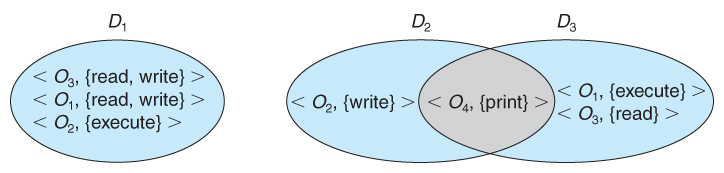
Domains may share access rights. For example, in Figure 14.1, we have
three domains: D1, D2, and D3. The access right <O4, {print}> is shared by D2
and D3, implying that a process executing in either of these two domains can
print object O4. Note that a process must be executing in domain D1 to read
and write object O1, while only processes in domain D3 may execute object O1.
The association between a process and a domain may be either static, if
the set of resources available to the process is fixed throughout the process’s
lifetime, or dynamic. As might be expected, establishing dynamic protection
domains is more complicated than establishing static protection domains.
If the association between processes and domains is fixed, and we want to
adhere to the need-to-know principle, then a mechanism must be available to
change the content of a domain. The reason stems from the fact that a process
may execute in two different phases and may, for example, need read access
in one phase and write access in another. If a domain is static, we must define
the domain to include both read and write access. However, this arrangement
provides more rights than are needed in each of the two phases, since we have
read access in the phase where we need only write access, and vice versa.
Thus, t
he need-to-know principle is violated. We must allow the contents of
a domain to be modified so that the domain always reflects the minimum
necessary access rights.
If the association is dynamic, a mechanism is available to allow domain
switching, enabling the process to switch from one domain to another.We may
also want to allow the content of a domain to be changed. If we cannot change
the content of a domain, we can provide the same effect by creating a new
domain with the changed content and switching to that new domain when we
want to change the domain content.
A domain can be realized in a variety of ways:
• Each user may be a domain. In this case, the set of objects that can be
accessed depends on the identity of the user. Domain switching occurs
when the user is changed—generally when one user logs out and another
user logs in.
• Each process may be a domain. In this case, the set of objects that can be
accessed depends on the identity of the process. Domain switching occurs
when one process sends a message to another process and then waits for
a response.
• Each procedure may be a domain. In this case, the set of objects that can be
accessed corresponds to the local variables defined within the procedure.
Domain switching occurs when a procedure call is made.
We discuss domain switching in greater detail in Section 14.4.
Consider the standard dual-mode (monitor–user mode) model of
operating-system execution. When a process executes in monitor mode, it
can execute privileged instructions and thus gain complete control of the
computer system. In contrast, when a process executes in user mode, it can
invoke only nonprivileged instructions. Consequently, it can execute only
within its predefined memory space. These two modes protect the operating
system (executing in monitor domain) from the user processes (executing
in user domain). In a multiprogrammed operating system, two protection
domains are insufficient, since users also want to be protected from one
another. Therefore, a more elaborate scheme is needed. We illustrate such a
scheme by examining two influential operating systems—UNIX and MULTICS
—to see how they implement these concepts.
14.3.2 An Example: UNIX
In the UNIX operating system, a domain is associated with the user. Switching
the domain corresponds to changing the user identification temporarily.
This change is accomplished through the file system as follows. An owner
identification and a domain bit (known as the setuid bit) are associated with
each file. When the setuid bit is on, and a user executes that file, the userID is
set to that of the owner of the file. When the bit is off, however, the userID
does not change. For example, when a user A (that is, a user with userID =
A) starts executing a file owned by B, whose associated domain bit is off, the
userID of the process is set to A. When the setuid bit is on, the userID is set tothat of the owner of the file: B. When the process exits, this temporary userID
change ends.
Other methods are used to change domains in operating systems in which
userIDs are used for domain definition, because almost all systems need
to provide such a mechanism. This mechanism is used when an otherwise
privileged facility needs to be made available to the general user population.
For instance, it might be desirable to allow users to access a network without
letting them write their own networking programs. In such a case, on a UNIX
system, the setuid bit on a networking program would be set, causing the
userID to change when the program was run. The userID would change to
that of a user with network access privilege (such as root, the most powerful
userID). One problem with this method is that if a user manages to create a file
with userID root and with its setuid bit on, that user can become root and
do anything and everything on the system. The setuid mechanism is discussed
further in Appendix A.
An alternative to this method used in some other operating systems is
to place privileged programs in a special directory. The operating system is
designed to change the userID of any program run from this directory, either
to the equivalent of root or to the userID of the owner of the directory. This
eliminates one security problem, which occurs when intruders create programs
to manipulate the setuid feature and hide the programs in the system for later
use (using obscure file or directory names). This method is less flexible than
that used in UNIX, however.
Even more restrictive, and thus more protective, are systems that simply
do not allow a change of userID. In these instances, special techniques must
be used to allow users access to privileged facilities. For instance, a daemon
process may be started at boot time and run as a special userID. Users then
run a separate program, which sends requests to this process whenever they
need to use the facility. This method is used by the TOPS-20 operating system.
In any of these systems, great care must be taken in writing privileged
programs. Any oversight can result in a total lack of protection on the system.
Generally, these programs are the first to be attacked by people trying to
break into a system. Unfortunately, the attackers are frequently successful.
For example, security has been breached on many UNIX systems because of the
setuid feature.We discuss security in Chapter 15.
14.3.3 An Example: MULTICS
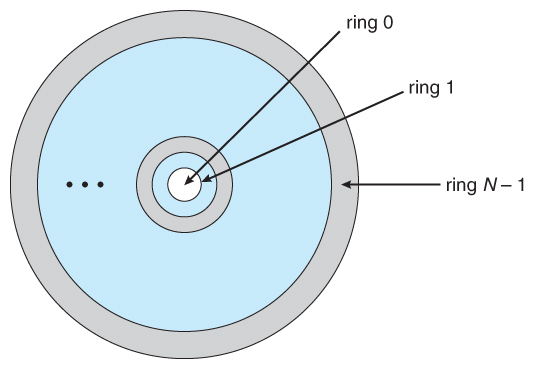
In the MULTICS system, the protection domains are organized hierarchically
into a ring structure. Each ring corresponds to a single domain (Figure 14.2).
The rings are numbered from 0 to 7. Let Di and Dj be any two domain rings.
If j < i, then Di is a subset of Dj . That is, a process executing in domain Dj
has more privileges than does a process executing in domain Di. A process
executing in domain D0 has the most privileges. If only two rings exist, this
scheme is equivalent to the monitor–user mode of execution, where monitor
mode corresponds to D0 and user mode corresponds to D1.
MULTICS has a segmented address space; each segment is a file, and each
segment is associated with one of the rings. A segment description includes an
entry that identifies the ring number. In addition, it includes three access bits
to control reading, writing, and execution. The association between segments
and rings is a policy decision with which we are not concerned here.
A current-ring-number counter is associated with each process, identifying
the ring in which the process is executing currently. When a process is
executing in ring i, it cannot access a segment associated with ring j (j < i). It
can access a segment associated with ring k (k ≥ i). The type of access, however,
is restricted according to the access bits associated with that segment.
Domain switching in MULTICS occurs when a process crosses fromone ring
to another by calling a procedure in a different ring. Obviously, this switch must
be done in a controlled manner; otherwise, a process could start executing in
ring 0, and no protection would be provided. To allow controlled domain
switching, we modify the ring field of the segment descriptor to include the
following:
• Access bracket. A pair of integers, b1 and b2, such that b1 ≤ b2.
• Limit. An integer b3 such that b3 > b2.
• List of gates. Identifies the entry points (or gates) at which the segments
may be called.
If a process executing in ring i calls a procedure (or segment) with access bracket
(b1,b2), then the call is allowed if b1 ≤ i ≤ b2, and the current ring number of
the process remains i. Otherwise, a trap to the operating system occurs, and
the situation is handled as follows:
• If i < b1, then the call is allowed to occur, because we have a transfer to a
ring (or domain)with fewer privileges. However, if parameters are passed
that refer to segments in a lower ring (that is, segments not accessible to
the called procedure), then these segments must be copied into an area
that can be accessed by the called procedure.
• If i > b2, then the call is allowed to occur only if b3 is greater than or equal
to i and the call has been directed to one of the designated entry points inthe list of gates. This scheme allows processes with limited access rights to
call procedures in lower rings that have more access rights, but only in a
carefully controlled manner.
The main disadvantage of the ring (or hierarchical) structure is that it does
not allow us to enforce the need-to-know principle. In particular, if an object
must be accessible in domain Dj but not accessible in domain Di , thenwemust
have j < i. But this requirement means that every segment accessible in Di is
also accessible in Dj .
The MULTICS protection system is generally more complex and less efficient
than are those used in current operating systems. If protection interferes with
the ease of use of the system or significantly decreases system performance,
then its use must be weighed carefully against the purpose of the system. For
instance, we would want to have a complex protection system on a computer
used by a university to process students’ grades and also used by students for
classwork.Asimilar protection system would not be suited to a computer being
used for number crunching, in which performance is of utmost importance.We
would prefer to separate the mechanism from the protection policy, allowing
the same system to have complex or simple protection depending on the needs
of its users. To separate mechanism from policy, we require a more general
model of protection.
14.4 Access Matrix
Our general model of protection can be viewed abstractly as a matrix, called
an access matrix. The rows of the access matrix represent domains, and the
columns represent objects. Each entry in the matrix consists of a set of access
rights. Because the column defines objects explicitly, we can omit the object
name from the access right. The entry access(i,j) defines the set of operations
that a process executing in domain Di can invoke on object Oj .
To illustrate these concepts, we consider the access matrix shown in Figure
14.3. There are four domains and four objects—three files (F1, F2, F3) and one
laser printer. A process executing in domain D1 can read files F1 and F3. A
process executing in domain D4 has the same privileges as one executing in

domain D1; but in addition, it can also write onto files F1 and F3. The laser
printer can be accessed only by a process executing in domain D2.
The access-matrix scheme provides us with the mechanism for specifying
a variety of policies. The mechanism consists of implementing the access
matrix and ensuring that the semantic properties we have outlined hold.
More specifically, we must ensure that a process executing in domain Di can
access only those objects specified in row i, and then only as allowed by the
access-matrix entries.
The access matrix can implement policy decisions concerning protection.
The policy decisions involve which rights should be included in the (i, j)th
entry. We must also decide the domain in which each process executes. This
last policy is usually decided by the operating system.
The users normally decide the contents of the access-matrix entries. When
a user creates a new object Oj, the column Oj is added to the access matrix
with the appropriate initialization entries, as dictated by the creator. The user
may decide to enter some rights in some entries in column j and other rights
in other entries, as needed.
The access matrix provides an appropriate mechanism for defining and
implementing strict control for both static and dynamic association between
processes and domains. When we switch a process fromone domain to another,
we are executing an operation (switch) on an object (the domain). We can
control domain switching by including domains among the objects of the
access matrix. Similarly, when we change the content of the access matrix,
we are performing an operation on an object: the access matrix. Again, we
can control these changes by including the access matrix itself as an object.
Actually, since each entry in the access matrix can be modified individually,
we must consider each entry in the access matrix as an object to be protected.
Now, we need to consider only the operations possible on these new objects
(domains and the access matrix) and decide how we want processes to be able
to execute these operations.
Processes should be able to switch from one domain to another. Switching
from domain Di to domain Dj is allowed if and only if the access right switch
∈ access(i, j). Thus, in Figure 14.4, a process executing in domain D2 can switchone in domain D1 can switch to D2.
Allowing controlled change in the contents of the access-matrix entries
requires three additional operations: copy, owner, and control. We examine
these operations next.
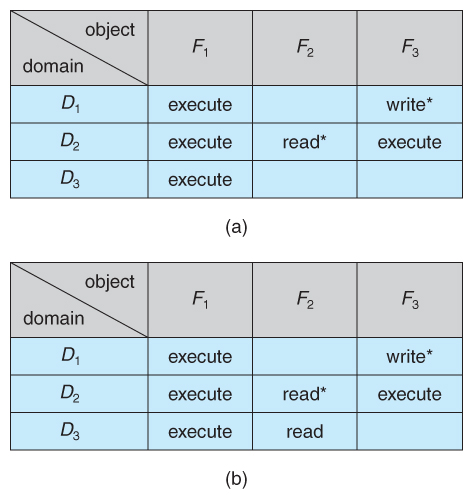
The ability to copy an access right from one domain (or row) of the access
matrix to another is denoted by an asterisk (*) appended to the access right.
The copy right allows the access right to be copied only within the column
(that is, for the object) for which the right is defined. For example, in Figure
14.5(a), a process executing in domain D2 can copy the read operation into any
entry associated with file F2. Hence, the access matrix of Figure 14.5(a) can be
modified to the access matrix shown in Figure 14.5(b).
This scheme has two additional variants:
1. A right is copied from access(i, j) to access(k, j); it is then removed from
access(i, j). This action is a of a right, rather than a copy.
2. Propagation of the copy right may be limited. That is, when the right
R∗ is copied from access(i, j) to access(k, j), only the right R (not R∗)
is created. A process executing in domain Dk cannot further copy the
right R.
A system may select only one of these three copy rights, or it may provide
all three by identifying them as separate rights: copy, transfer, and limited
copy. We also need a mechanism to allow addition of new rights and removal of
some rights. The owner right controls these operations. If access(i, j) includes
the owner right, then a process executing in domain Di can add and remove
any right in any entry in column j. For example, in Figure 14.6(a), domain D1
is the owner of F1 and thus can add and delete any valid right in column F1.
Similarly, domain D2 is the owner of F2 and F3 and thus can add and remove
any valid right within these two columns. Thus, the access matrix of Figure
14.6(a) can be modified to the access matrix shown in Figure 14.6(b).
The copy and owner rights allow a process to change the entries in a
column. A mechanism is also needed to change the entries in a row. The
control right is applicable only to domain objects. If access(i, j) includes the
control right, then a process executing in domain Di can remove any access
right from row j. For example, suppose that, in Figure 14.4, we include the
control right in access(D2, D4). Then, a process executing in domain D2
could modify domain D4, as shown in Figure 14.7.
The copy and owner rights provide us with a mechanism to limit the
propagation of access rights. However, they do not give us the appropriate tools
for preventing the propagation (or disclosure) of information. The problem of
guaranteeing that no information initially held in an object can migrate outside
of its execution environment is called the confinement problem. This problem
is in general unsolvable (see the bibliographical notes at the end of the chapter).
These operations on the domains and the access matrix are not in themselves
important, but they illustrate the ability of the access-matrix model to
allow us to implement and control dynamic protection requirements. New
objects and new domains can be created dynamically and included in theaccess-matrix model. However, we have shown only that the basic mechanism
exists. System designers and users must make the policy decisions concerning
which domains are to have access to which objects in which ways.


Tidak ada komentar:
Posting Komentar